That "Compostable" Coffee Bag Isn't Going to Break Down in Your Backyard Bin
Most "compostable" packaging needs an industrial facility most of us don't have access to, so it often just sits in landfill looking smug.
I used to feel a small glow of virtue every time I tossed a "compostable" produce bag or coffee pouch into my backyard compost bin. Look at me, closing the loop. Except months later, when I turned the pile, there it'd be. Same shape. Slightly sad, a little floppy, but fundamentally still a bag. Turns out I wasn't doing it wrong. The label was just not telling me the whole story.
The word "compostable" is doing a lot of unearned work
Here's the thing nobody puts on the front of the package in big friendly letters: there are two very different kinds of compostable, and most packaging is only certified for one of them. Industrial (also called commercial) composting facilities run hot, really hot, holding materials at around 55 to 60 degrees Celsius with controlled moisture and constant aeration. Your backyard pile, even a well-tended one, typically hovers between 20 and 30 degrees Celsius with whatever moisture and microbial life happens to show up. That's not a minor gap. It's the difference between a industrial oven and a windowsill.
The main US certifier, the Biodegradable Products Institute, built its whole reputation on testing packaging against ASTM standards for exactly that hot, managed industrial environment. For most of its history, BPI certification said nothing at all about whether a product would break down in a home bin, and it only introduced a combined commercial-and-home certification in September 2025. So the overwhelming majority of "BPI Certified Compostable" packaging still sitting on shelves and in warehouses was never tested for backyard conditions in the first place, because that wasn't the point of the certification.
Why your compost pile isn't the problem
If you've ever fished out a "compostable" fork or bag looking exactly like it did going in, it's not because you're bad at composting. A packaging industry breakdown puts it plainly: because home piles run at lower, less consistent temperatures, compostable materials tend to break down more slowly there than in industrial settings, and a lot of what's on the market is certified industrial but not home compostable at all. Your pile is doing its job. The packaging was just built for a hotter, more aggressive environment than your yard provides.
And landfill is worse, not neutral
This is the part that actually bugs me. If that industrially-certified bag doesn't make it to an industrial facility (and most people don't have curbside compost pickup, and there are only around 185 full-time commercial composting facilities in the entire US), it usually ends up in the regular trash. Landfills are engineered to be dry, compacted, and sealed off from oxygen specifically to control leachate and gas, which means the microbes that break down compostable plastics can't do their work. Researchers who buried compostable and biodegradable bags in soil for three years found that even the "compostable" ones failed to decompose in that environment, essentially getting mummified rather than composted. So the eco-friendly bag doesn't get a pass in a landfill, it just persists there quietly, sometimes for decades, occasionally generating methane in the process instead of turning into anything resembling soil.
How to actually tell the difference on the label
The good news is the labeling problem is solvable once you know what to look for. Skip anything that just says "biodegradable," that word is unregulated and legally distinct from "compostable," and it tells you nothing about timeframe or conditions. Instead look for an actual certification mark and read which environment it's certified for. TÜV Austria's "OK Compost INDUSTRIAL" and BPI's standard certification both mean commercial facility only. TÜV Austria's "OK Compost HOME" mark, or BPI's newer combined Commercial & Home certification, means it's actually been tested to break down at those lower backyard temperatures within about a year. If the package just has a green leaf and the word "compostable" with no logo or certification number, that's marketing, not a promise.
What I actually do now
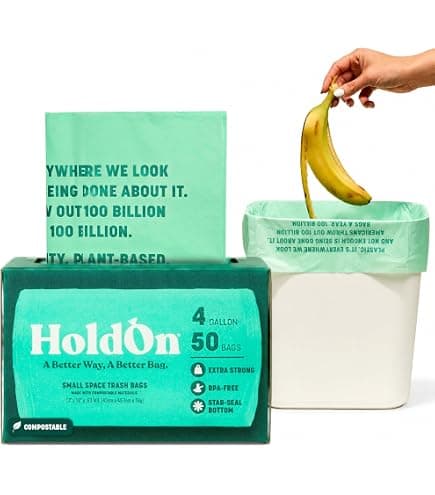
I stopped assuming and started checking. For anything I plan to put in my own bin, I look specifically for the OK Compost HOME seal or BPI's home certification, not just any compostable claim. For packaging that's only industrially certified, I check whether my city has a curbside or drop-off composting program (a surprising number of mid-size cities do now) before I buy, rather than after. And for the one category I go through constantly, kitchen and trash bin liners, I've switched to bags that carry both TÜV Home and BPI certification, so they're covered whether they end up in my backyard pile or a commercial stream. The HoldOn compostable small kitchen bags are a solid example of this dual-certified approach, and they hold up fine for regular kitchen duty in the meantime.
None of this requires buying anything new or feeling bad about the last five years of well-intentioned bag tossing. It just means reading the actual certification instead of the vibe of the packaging, and being honest with yourself about whether the "compostable" thing you're buying has anywhere real to go. A label that only works in a facility you can't access isn't greenwashing exactly, but it's not far off either.
Get the HoldOn Compostable Small Kitchen Bags, 4 Gallon (TUV Certified Home Compostable, BPI Certified)
Ad, affiliate link: we earn a commission when you buy through this link. The price stays the same for you.
Shop on AmazonLiked this? There are 10 more swaps.
The free checklist covers kitchen, bathroom, and shopping. Every swap researched like this one.