Do Smart Power Strips Actually Save You Money? I Ran the Numbers
Phantom power quietly drains $50-150 a year from every home office. Here's the real math on whether a smart power strip is worth buying.
Phantom power sounds like a ghost story utilities invented to sell you gadgets, but it is a real thing, and it is quietly running up your electric bill right now. Your TV, your desktop, your printer, your cable box, they all sip electricity even when they look off. The question isn't whether this happens. It's whether buying a fancy power strip to stop it is actually worth the money, or just another drawer-filler like that bread maker you used twice.
What phantom power actually costs you
According to the U.S. Department of Energy, phantom loads can account for 5% to 10% of your household electricity use, which could mean $50 to $150 a year just from things that appear to be "off." One utility puts it more precisely: U.S. households spend approximately $100 per year to power devices while they are in a low power mode, roughly 8% of household electricity costs. That's not nothing, but it's also not going to fund your retirement. Context matters here.
Where does that waste actually live? Phantom load devices can be anything that draws power while idle, and in most homes that includes cable or streaming boxes, gaming consoles, desktop PCs, monitors and printers, Wi-Fi routers, and small appliances with clocks or status lights. If you work from home with a desktop, two monitors, a printer, and speakers, that's basically a phantom power buffet sitting under your desk right now.
So does the strip actually pay for itself
Here's where it gets interesting, and where a lot of marketing copy gets sloppy. One energy analyst's breakdown found that a smart strip aimed at an entertainment center or home office setup can cut standby power by 25-50 watts, saving around $4-7 per month, or $50-85 annually, with payback within 12 months on a $25 to $40 strip. That's a genuinely solid return, basically doubling your money in year one and pure savings after that.
But before you get too excited, there's a reality check worth sitting with. One field analysis found that a smart-strip intervention saved only $7.98 annually, with the argument that the real savings come from smart lighting systems and smart thermostats, meaning if you have just a few devices, you will save less. So the honest answer is "it depends entirely on how much stuff you leave plugged in and how efficient that stuff already is." A gaming setup with a beefy PC and dual monitors is a much better candidate than a laptop and a lamp.
The cheap option vs. the fancy option
You don't need Wi-Fi and an app to get most of the benefit. A basic master-controlled strip, the kind where you plug your TV or PC into the "control" outlet and everything else automatically cuts off when it powers down, runs about $15 to $25 and does the bulk of the work. These strips sense usage and automatically shut off electricity, saving up to $84 a year in energy costs in the right setup, no app required.
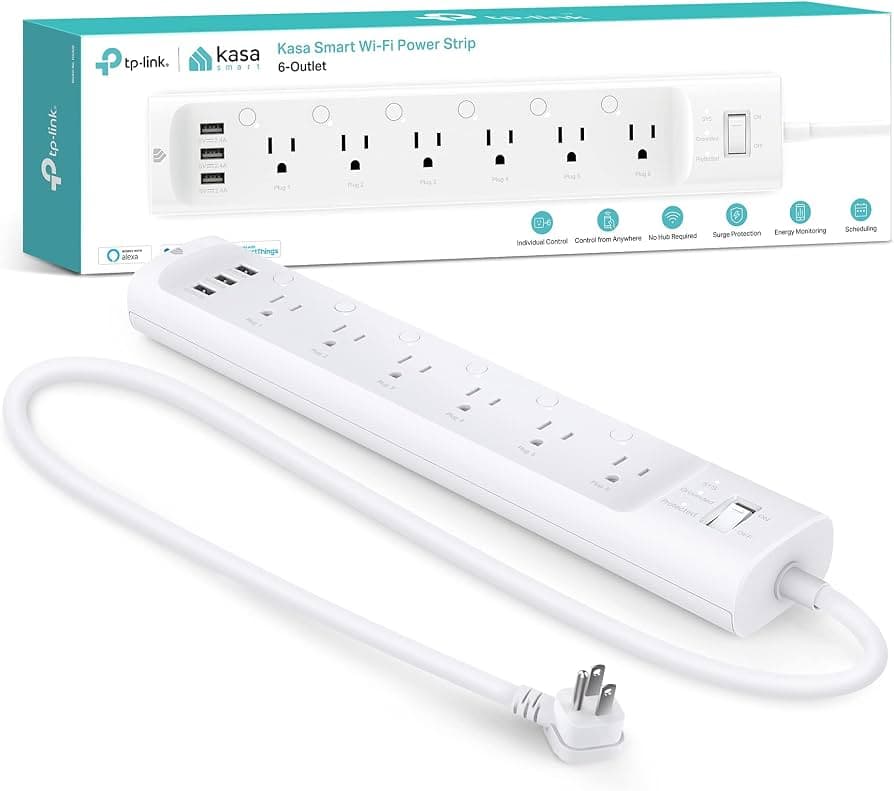
If you want energy monitoring, scheduling, and voice control on top of that, the TP-Link Kasa Smart Power Strip HS300 is the one most reviewers land on. It gives you six independently controlled outlets plus USB charging ports, and it's built for family rooms, home offices, or small businesses, letting you power things up remotely and even control holiday lights from your phone. It typically runs somewhere between $35 and $50 depending on sales, occasionally dipping lower during Prime events, though its list price sits closer to $80. It's a nicer tool, but the app and monitoring are more about convenience and curiosity than they are about squeezing out extra savings versus the cheap mechanical version.
Where to actually put one
Skip the kitchen fridge (never put a major appliance on a switched outlet) and skip anything safety-related like a security system or a router you need running overnight. The best real estate is your entertainment center and your home office desk, since home offices are perfect candidates because so much gear sits idle outside work hours. Plug your monitor, speakers, and printer into the switched outlets and your computer into the control outlet, and you're done thinking about it.
The bottom line
If your home office or entertainment setup has more than two or three devices constantly idling, a $20-40 power strip will likely pay for itself within a year and keep saving quietly after that, no lifestyle change required. If you're already running a lean setup with just a laptop and a lamp, save your money and put it toward something with a bigger payoff, like a smart thermostat. Either way, it's a rare sustainability upgrade that doesn't ask you to change a single habit. You just plug it in and let it do the nagging for you.
Get the Kasa Smart Plug Power Strip HS300, Surge Protector with 6 Individually Controlled Smart Outlets and 3 USB Ports
Ad, affiliate link: we earn a commission when you buy through this link. The price stays the same for you.
Shop on AmazonLiked this? There are 10 more swaps.
The free checklist covers kitchen, bathroom, and shopping. Every swap researched like this one.