Do Low-Flow Showerheads Actually Save Money, or Is It Just a Weaker Shower?
A $15-30 showerhead swap sounds too easy to be real savings. Here's the actual math on water, energy, and whether your shower still feels good.
Let's get the trauma out of the way first. If you grew up with a "low-flow" showerhead, you remember it: a sad little dribble that made rinsing shampoo out of long hair feel like a punishment. That reputation is doing a lot of work to keep people from trying this swap, and it's mostly outdated.
Here's the actual mechanism, because it matters for the math later. Standard showerheads made before efficiency rules use about 2.5 gallons per minute, which is also still the federal legal maximum set by the Energy Policy Act of 1992. A WaterSense-certified showerhead has to use no more than 2.0 gpm, and plenty of models now go lower than that, down to 1.8, 1.5, or even under 1 gpm for the aggressively efficient ones. The EPA doesn't just check the flow rate either. WaterSense labeled showerheads must meet performance attributes identified through consumer testing, including flow rate across a range of pressures and spray force, so a "certified" showerhead has actually been tested on people who'd complain if it felt weak.
The old bad ones from the 90s got their reputation because manufacturers just choked the pipe without redesigning anything else. Modern versions use pressure-compensating valves and aeration or nozzle redesigns to keep the spray feeling strong while using less water, which is a genuinely different approach than "put your thumb over the hose."
The actual dollar math
Showering is one of the biggest indoor water uses in a typical house, accounting for close to 17 percent of residential indoor water use, and for an average family that's something like 40 gallons a day just standing under the spray. Swapping in a WaterSense showerhead typically cuts that water use by 20 to 40 percent depending on your old fixture.
The EPA's own estimate is that replacing an old showerhead with a WaterSense one can save about $70 a year in combined water and energy costs for a household. That energy piece matters more than people think, because you're not just paying for the water, you're paying to heat it, and water heating makes up roughly 18 percent of a home's energy bill. Cut the hot water flow and you cut both bills at once, which is why this swap has a better payback than almost anything else in the bathroom.
Given that a solid WaterSense showerhead runs somewhere between $15 and $60, you're generally looking at a payback period measured in weeks, not years. Even the cheap end of that range pays for itself in a single billing cycle for a lot of households. Compare that to something like a bidet attachment, where the math depends heavily on toilet paper prices and household size. A showerhead is close to a guaranteed win because everyone showers, and everyone's water heater is working overtime to keep up with a 2.5 gpm head that's basically just rinsing money down the drain.
What to actually buy
Skip the unbranded $12 showerheads with vague "low flow" claims on the packaging, since a lot of them just restrict flow without the pressure-compensating design that keeps performance decent, and reviewers report exactly the weak-dribble experience that gives the category a bad name. Stick to something that's actually WaterSense certified, which you can verify on the EPA's site, and expect to spend closer to $20 to $40 for one that won't disappoint you.
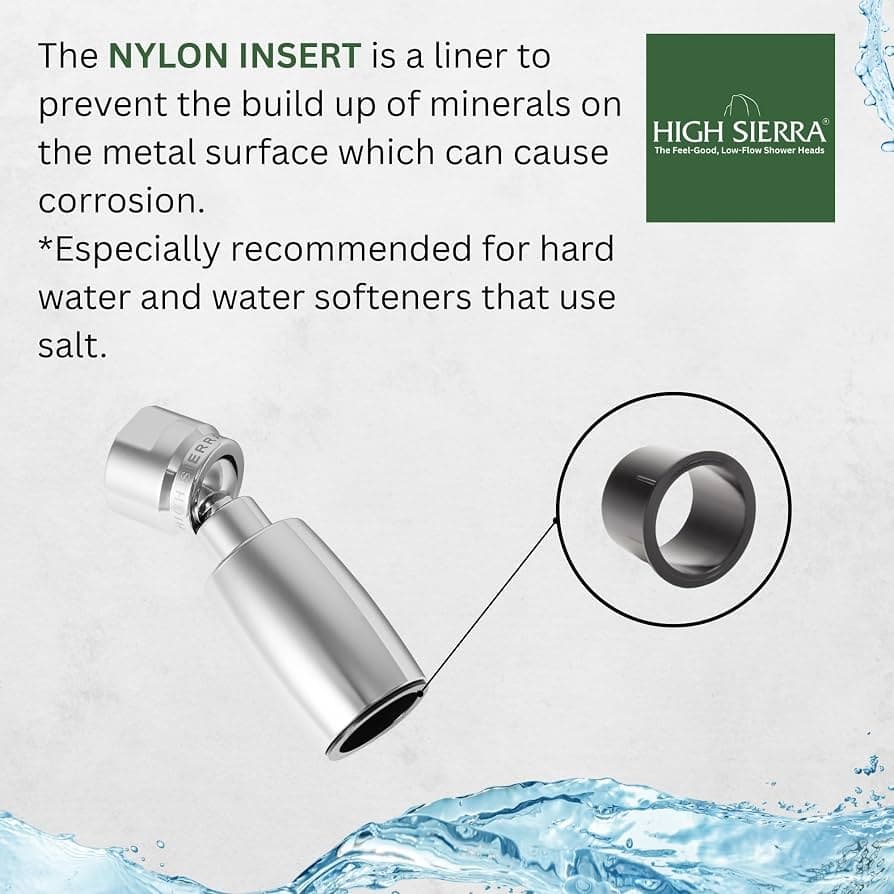
A good example on the more efficient end is the High Sierra Showerheads solid metal 1.8 GPM model, which is WaterSense certified and built around a patented single-nozzle design meant to resist the mineral clogging that kills cheaper showerheads over time. It's marketed as saving 25 percent or more on water and the water heating energy that goes with it, and it comes in a trickle-valve version so you can shut the flow down to almost nothing while you're lathering up, which stacks even more savings on top.
The install part nobody warns you about
This is genuinely a five-minute job. Unscrew the old showerhead (a wrench helps if it's been on there since the Clinton administration), wrap the threads with plumber's tape, and hand-tighten the new one. No plumber, no tools beyond maybe a wrench, no drama. If your water pressure is already weak because of old pipes, look for a model with a pressure-compensating valve specifically, since those are built to maintain flow even at lower psi rather than making a weak situation worse.
The bottom line
This is one of the rare sustainability swaps where the environmental case and the financial case point the exact same direction with almost no tradeoff. You're not sacrificing shower quality if you buy a real WaterSense model instead of a bargain-bin one, and the payback is fast enough that it barely counts as an investment. If you've been putting this off because you remember the weak showerheads of decades past, it might be time to give the modern versions another shot.
Get the High Sierra Showerheads Solid Metal 1.8 GPM High-Efficiency, Low-Flow Shower Head - Chrome
Ad, affiliate link: we earn a commission when you buy through this link. The price stays the same for you.
Shop on AmazonLiked this? There are 10 more swaps.
The free checklist covers kitchen, bathroom, and shopping. Every swap researched like this one.