Best Countertop Compost Bins: What's Actually Worth Buying (and What's Just a Fancy Trash Can)
From $20 bins to $600 electric composters, here's the real cost and function breakdown of what's worth buying for collecting kitchen scraps.
If you read our banana peel post, you already know the "landfill food scraps make methane" problem is real. So naturally the next question is: fine, I'll start collecting scraps, what do I actually buy? Turns out the countertop compost bin market ranges from a $13 plastic pail to an $899 machine that promises to do the composting for you overnight. I dug through the real options so you don't have to buy three bins before finding one that doesn't smell up your kitchen.
Tier 1: The no-frills bin ($13 to $30)
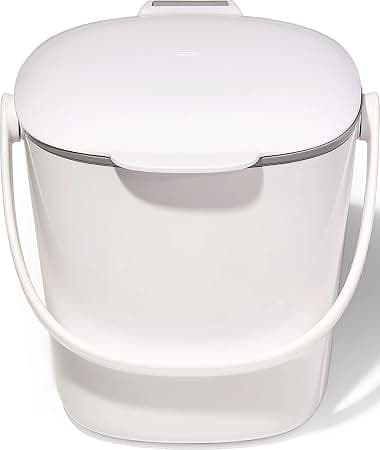
The OXO Good Grips Easy-Clean Compost Bin is the one most people land on, and for good reason. It was designed with the home cook in mind, with a flip-up lid that can be opened and closed with one hand and keeps odors contained. The sturdy handle makes it easy to carry the filled bin and smooth interior walls make cleanup simple. It runs somewhere between $20 and $30 depending on size, and if all you're doing is stashing scraps for a day or two before dumping them in a backyard pile or a municipal drop-off, this is genuinely enough. You don't need a smart appliance to hold onion skins.
Tier 2: The one you don't mind leaving out ($45 to $65)
If your countertop bin needs to also look nice because your kitchen is small and everything is visible, the Bamboozle Astrik is the upgrade. It's made from biodegradable bamboo fibers, a renewable resource, and the material is resistant to moisture and heat, making the bin both durable and dishwasher-safe. The lid uses dishwasher-safe carbon filters, sold separately, to minimize odors and also features ventilation holes for further air circulation. It typically runs $49 to $65 depending on retailer and color, which is real money for what's essentially a bucket with a lid, but if the alternative is a stainless mixing bowl sitting out on the counter, the style tax might be worth it to you.
Tier 3: The electric composter, and what it's actually doing
This is where it gets interesting, and where the marketing gets a little slippery. Machines like the Vitamix FoodCycler and Lomi by Pela get pitched as "compost overnight" devices. Here's the myth-bust part: unlike backyard compost piles, worm bins, or municipal composting services, these machines don't actually create compost. It's not a composter, it's a dehydrator. It's not eco-neutral either, since it consumes meaningful electricity, and the output isn't soil, it's dried food that still needs actual composting.
That doesn't mean they're useless, it just means you're buying a food waste shrinker, not a compost factory. These small appliances tend to be about the size of a breadmaker, use a carbon filter to reduce smells, and can reduce food waste in less than a day instead of the months backyard composting takes. The FoodCycler runs cheaper, priced around $399 compared to Lomi's roughly $499, and the FoodCycler has a slightly smaller bucket capacity than Lomi for that lower price. Lomi's one real edge is handling bioplastics, since it can process certain compostable plastics that backyard bins and the FoodCycler can't touch. Unless you're regularly tossing compostable takeout containers, that feature won't matter much to the average household.
If you want something that produces genuinely finished, plant-ready compost rather than dried grounds, that's a different machine entirely. The Reencle Prime, priced around $549, is the rare option in this category that produces actual compost using live microbes, while the FoodCycler, Lomi, and similar machines are essentially dehydrators that shrink food waste into dry material needing further processing before it works as compost. That's a meaningful distinction if your end goal is actually feeding your garden, not just shrinking your trash bag.
So which one should you actually buy?
If you have any access to backyard composting, curbside organics pickup, or a farmers market drop-off, buy the $25 OXO bin and call it done. The scraps are going somewhere that already knows how to compost them, so you don't need a $400 appliance duplicating that job on your counter. The Bamboozle is worth the extra $30 to $40 purely on the "will this be visible on my counter for the next five years" question, nothing more. And the electric composters make the most sense specifically for apartment dwellers with zero outdoor access and no curbside program, who need the volume reduction and smell control more than they need actual finished compost.
The bottom line
None of these bins are the sustainability win by themselves, they're just the collection step. The actual impact happens when those scraps go somewhere that turns them into compost instead of landfill methane. Buy the cheapest bin that fits that pipeline, and skip the $600 machine unless your situation genuinely has no other composting option.
Get the OXO Good Grips Easy-Clean Compost Bin, White - 0.75 GAL
Ad, affiliate link: we earn a commission when you buy through this link. The price stays the same for you.
Shop on AmazonLiked this? There are 10 more swaps.
The free checklist covers kitchen, bathroom, and shopping. Every swap researched like this one.